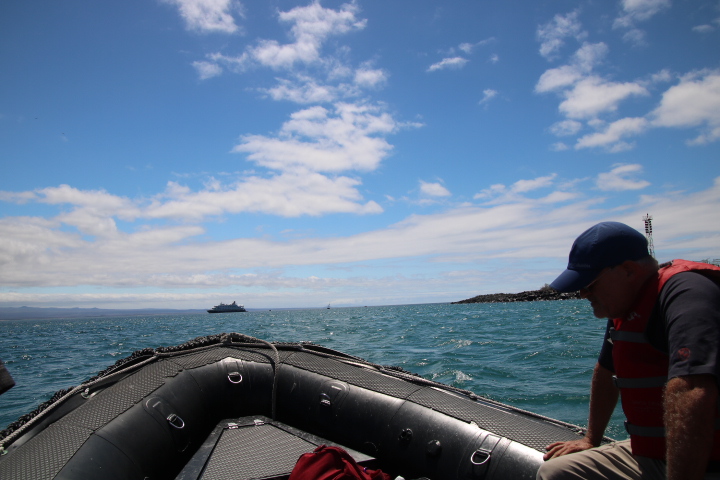
Today we flew from Quito to the islands and at lunchtime embarked upon the MS Santa Cruz II and moved to a remote part of Santa Cruz Island for our introduction to the area.


The Galapagos Islands were formed by volcanic activity around 10 – 3 million years ago. In geological terms they are very young because they are situated on a ‘Hot Spot’ and not directly on a crustal plate boundary which is along the coastline of the South American continent. There are 19 volcanic islands, of which only five are inhabited, and many tiny islets which in total cover 60,000 square kilometres of the eastern Pacific. Ocean currents play an important part in the climate and ecology of the islands as warm and cold currents collide here from both sides of the Equator.
The island’s discovery by people may have been during pre-Inca times (as we witnessed in Lima, Peru) but documented evidence dates to the 1535 Spanish Conquest. At that time it is thought that a lack of fresh water delayed further exploration around the islands.
Shortly after the Spanish Conquest the islands were home to pirates and whalers.
It was not until Charles Darwin’s visit in 1835 on The Beagle and his subsequent book “On the origin of the species (1859)” that the islands were recognised for their biodiversity and their eventual protection as a National Park in 1959 and the protection of its surrounding waters in 1998.