Tasmania is another product of the breakup of the ancient Gondwanaland continent. We saw the evidence of the breakaway of New Zealand from Australia but here in Tasmania the island broke away along with Antarctica as individual landmasses, which is why the island has more in common geologically with Antarctica. Glaciation has been a major erosive force and the island’s central plateau was a permanent icecap. There are large deposits of dolerite on the island and, in places along the coast, erosion has produced fluted columns.
Colonial occupation began in the 1830s with the Dutch attempting to develop settlements and trade which failed as the French and the British arrived with sealers and whalers already expert traders. The British established a colony at what is now Hobart leaving the French with only names of places and roads. The British engaged in the then established use of convict labour, an abundant source for Britain and called Transportation. This ended on the island in 1853 when the original name ‘Van Diemen’s Land was changed to Tasmania. Fort Arthur was the major penal colony from 1833 with the inmates working to expand the settlement. Today the remains of the penal colony are considered one of the finest examples of 19th century convict settlements. Maria Island (1821) was the second penal colony but, by the 1830s, it was too expensive to run so the convicts were returned to the mainland (Australia). The whalers and sealers, farmers and smugglers moved in.
According to some travel guides Hobart’s isolated position maybe responsible for an ‘untouched’ landscape and heritage, making it similar to locations across the world that are remnants of the British Empire and make them ‘more British than Britain’ because most of the settlers were of Anglo-Saxon origin and wanted to preserve the feeling of homeland.
We arrived at 07:00 under cloud and rain, docking just metres from the waterfront and the city centre. Our walking tour today took us through ‘Nipaluna’, the colonial waterfront. Here, is the Macquarie Wharf and the headquarters of the Australian jam manufacturer IXL. Apparently the name comes from one of its workers who for years had applied the labels to the jars of jam and stated that whatever the job I do, I excel.


Around Constitution Dock are buildings erected on newly reclaimed land between the 1900s and 1930s. the Art Deco buildings seem to be modern compared to the Parliamentary and Council buildings which are in a UK public building style.


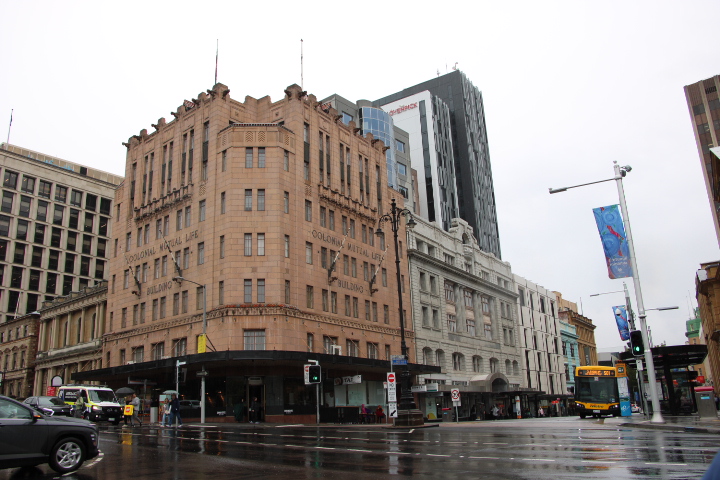


The tour returned to the waterfront through the Salamanca District of former warehouses that stores spirits, wine, fruit and fish.


Now soaked by the perpetual rain we returned to the ship passing the statue of Lois Bernacchi with his camera and sledge dog (Joe). This recalls the second Antarctica expedition of the Southern Cross (1898 – 1900). He was essentially a physicist, with a specialism in photography on the expedition that reached 78S and the McMurdo Sound. Then a new record. Upon returning to Hobart Bernacchi took a fast steamer to London and on 25th June 1900 began lectures and photograph displays for the Royal Geographical Society.


